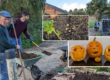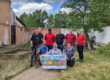


On Wednesday 27 May 2026, four corporate volunteers from Network Rail joined resident volunteer gardener Simon Kelly at Westbury Arts Centre in Shenley Wood, Milton Keynes, for a day of community gardening with Planting Up. The result exceeded our expectations…
The weather did its best to complicate things. After a heat wave earlier in the week, a storm the night before had mercifully cooled the air, and the morning brought ideal gardening conditions: sunshine, dappled cloud, and a gentle breeze. After lunch, however, the heat returned with a vengeance. Rumbles of thunder had threatened rain all day but never delivered. Instead, the afternoon turned uncomfortably warm and the team wrapped up a little earlier than the planned 3.30pm finish having worked really hard to accomplish more than had ever been planned.


A Permaculture Forest Garden, Years in the Making
The garden alongside the entry road to Westbury Arts Centre is no ordinary community plot. It started life as a grass patch back in 2017, when Planting Up first broke ground here using a lasagne mulch method, building up the soil layer by layer over the years to create the rich, living growing environment that underpins everything planted since.
From that foundation, the garden was developed into a forest garden following permaculture principles: a system of planting designed to mimic the structure of a natural woodland edge, with different layers of plants working together. Tall fruit trees form the canopy layer, currant bushes fill the shrub layer beneath, and a diverse range of edible, medicinal, and wildlife-friendly plants occupy the ground layers. Everything has a function. Everything supports something else. It is a garden designed, in the permaculture tradition, to largely take care of itself once established.
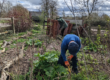
Over the past year the garden had become seriously overgrown. The woodchip path running through it had been completely engulfed by tall weeds, and the whole area had become difficult to navigate. The plan for the day was deliberately modest: tackle a quarter of the site, clear part of the path, and lay fresh woodchip mulch to define it again.


Tackling It in Small Steps
When Agnieszka Atkins, Cormac Jupe, Leonie Seymour, Matt Lai, and Simon Kelly first surveyed the site together, the scale of it was a lot to take in. But just as the old adage goes, the team broke it down into manageable zones, starting at the far end and working steadily towards the entrance. The focus was straightforward: pull out as many weeds and unwanted plants as possible, clear and re-establish the woodchip path, and mulch cleared ground to suppress regrowth.
They weren’t alone. A robin kept a close and very interested eye on proceedings throughout, swooping in to investigate every freshly turned patch of soil. A fitting companion for a wildlife-friendly garden.
By lunchtime it was already clear the team was making extraordinary progress. By the time tools were downed for the day, three quarters of the entire site had been cleared and brought back into a presentable, manageable state.


The Forest Garden Reveals Itself
This is where the years of permaculture planning paid off most visibly. As the weeds came away, the original plantings emerged in remarkably good health: well-established currant bushes, fruit trees, elephant garlic, and a wealth of other edible and medicinal plants, many of them quietly thriving despite a year of neglect. This is permaculture doing exactly what it promises: a garden designed with the right plants in the right places becomes increasingly resilient and self-sufficient over time, even when human attention lapses.
The forest garden layers were still clearly intact. The canopy, shrub, and ground layers were all present and accounted for. Some serious TLC is still needed, and there is more work to be done, but the structure and the soil built up since 2017 have held good. The garden has not been lost. It has been waiting.


Fresh woodchip was laid as mulch across the cleared areas, both to suppress regrowth and to restore the defined path that had long since disappeared beneath the vegetation.


A Huge Thank You
A massive thank you to Agnieszka Atkins, Cormac Jupe, Leonie Seymour, and Matt Lai from Network Rail for giving their time and energy so generously, and to Simon Kelly from the Westbury Arts Centre volunteer gardening team for his expertise and enthusiasm on the day. Thanks also to Frances Fox at Westbury Arts Centre and to Kirsty Forshaw at Planting Up MK for organising the event.
The garden has been given a new lease of life as the “before” and “after” shots really show well.
We hope this inspires a regular volunteer day resurgence at Westbury.


Corporate Volunteer Days Matter: Get Involved
This kind of work makes a genuine difference not just to the garden but to the community it serves. Westbury Arts Centre is a busy, creative hub in Shenley Wood, and the garden at its entrance is the first thing visitors see. This day of bringing our community garden back to life will make an enormous difference.
With Bucks Arts Weeks beginning on Saturday 6 June 2026, the timing of this volunteer day could not have been better. The garden is now in a much better state to welcome visitors to Westbury’s beautiful historic site and begins on the right footing to show off it’s appeal as a tranquil spot to enjoy combining art and nature.
Corporate volunteering days like this one are open to organisations of all sizes. If your team would like to get their hands dirty for a good cause in Milton Keynes, find out more on our corporate volunteer days page.